Product
Introducing JurisIQ: The AI Workspace Built for Indian Lawyers


Legal AI should not just answer questions. It should understand the matter, preserve context, connect research with drafting, and help Indian lawyers work from one intelligent legal workspace.
Most legal AI tools can answer a question. That is useful, but it is not enough.
Legal work is not a set of isolated prompts. It is a continuous body of facts, documents, court dates, research trails, arguments, client instructions, and procedural updates. A lawyer rarely asks a question in the abstract. The question belongs to a matter.
This is where many AI tools fall short. They help with a moment, but they do not understand the workspace around that moment. They can summarize a judgment, but not always why it matters to the case. They can draft a paragraph, but not always from the record, research, and strategy already built.
JurisIQ starts from a different idea: legal AI should live inside the matter. It should preserve context, connect work across stages, and help lawyers move from scattered information to a single intelligent workspace built for Indian legal practice.
The future of legal AI is not a smarter chatbot. It is a workspace that understands the matter you are working on.
Why Legal AI Needs to Evolve
The first wave of legal AI changed expectations. Lawyers now know that AI can summarize documents, explain judgments, extract clauses, create first drafts, and answer questions in natural language. But legal practice is more demanding than a single answer.
A litigation lawyer does not only need a summary of one judgment. They need to know whether it supports the active matter, whether there are contrary authorities, whether the procedural stage changes its usefulness, and whether similar work has already been done by the firm. Similarly, drafting does not begin with a blank page. A petition, reply, written submission, notice, or contract depends on facts, documents, prior drafts, legal research, client instructions, and strategy.
The real opportunity is not AI that answers faster. It is AI that carries context forward.
A useful legal AI system should be able to:
- Understand the active matter and procedural stage
- Search Indian legal materials with jurisdictional awareness
- Connect documents, facts, orders, and hearing history
- Preserve research trails so work is not repeated
- Assist drafting from the matter record
- Keep outputs reviewable through sources and citations
The question is no longer just, "Can AI answer this?" The better question is, *"Can AI understand the legal work around this?"*
The Problem With Today's Legal Workflow
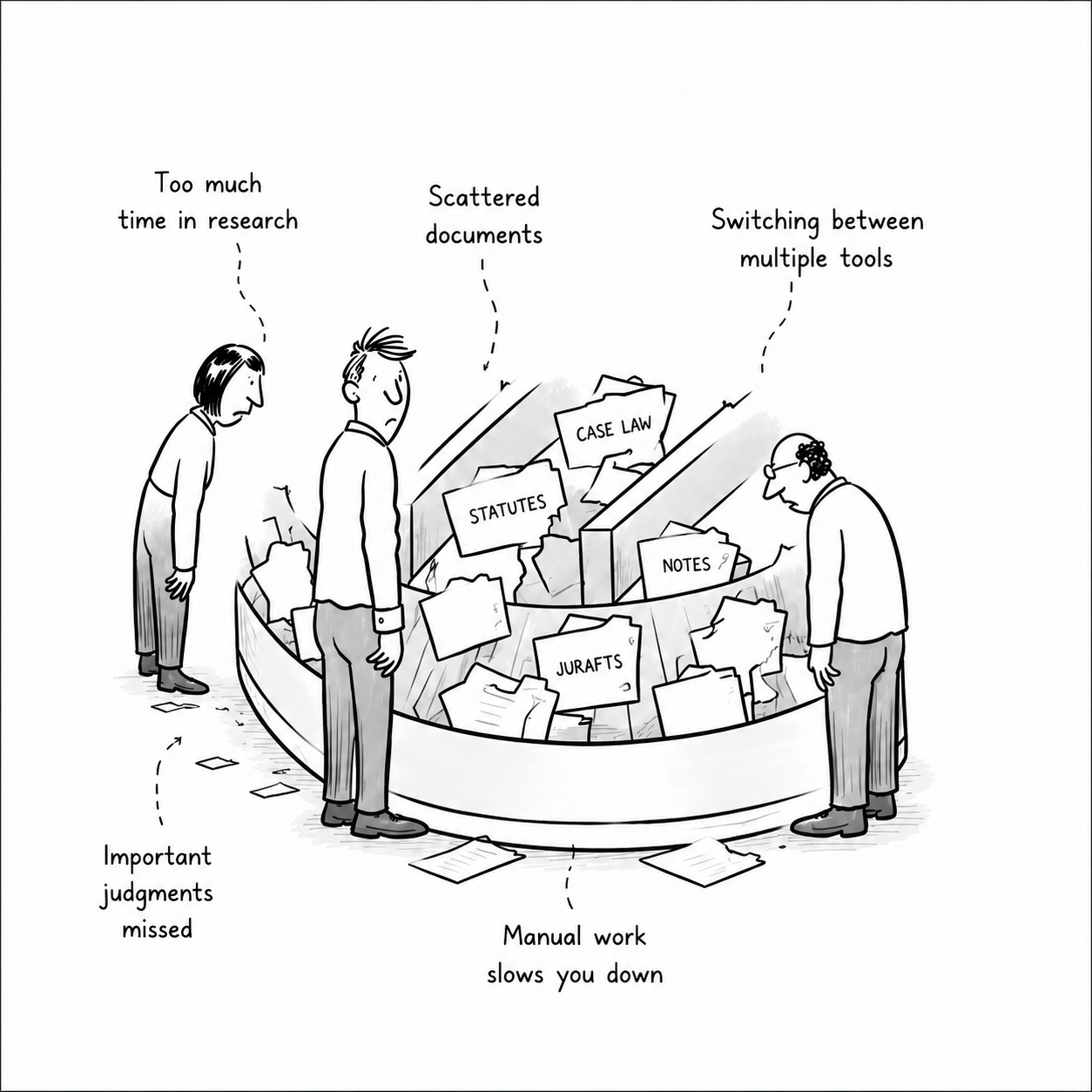
Modern legal work is fragmented. Research happens on one platform. Judgments are downloaded from another. Drafts live in word processors. Case documents sit in folders. Client communication happens over email and WhatsApp. Hearing updates come from court portals, clerks, cause lists, and internal notes.
Each tool performs a function, but none of them holds the matter together. The lawyer becomes the integration layer. Before a lawyer can think deeply, they must first gather context. Before drafting, they must locate the right documents. Before researching, they must remember the facts. Before a hearing, they must check orders, dates, notes, and previous submissions.

This gets harder as a practice grows. A lawyer handling ten matters can rely on memory. A team handling hundreds cannot. Research gets repeated. Drafting becomes inconsistent. Hearing updates get missed. Institutional knowledge stays trapped with individuals.
The problem is not that lawyers lack information. The problem is that information lives everywhere except inside the matter.
Meet JurisIQ
JurisIQ is an AI workspace built for Indian lawyers. It brings research, drafting, documents, hearings, communication, and matter knowledge into one connected environment. Instead of treating AI as a separate chat window, JurisIQ places AI inside the legal workflow itself.
The matter is the center of the system. Every document belongs to a matter. Every research note belongs to a matter. Every draft belongs to a matter. Every hearing update, order, citation, and AI interaction strengthens the matter's context.
This matters because legal work is cumulative. A lawyer should not have to explain the same background again and again. A team should not repeat research already completed in another case. A firm should not lose knowledge because a person moved away from a matter.
With JurisIQ, lawyers can:
- Research Indian case law in natural language
- Upload and organize matter documents
- Extract key facts, dates, parties, statutes, and issues
- Draft legal documents with matter-aware AI
- Track matter context across hearings and updates
- Preserve firm knowledge for future work
This is not AI as a side feature. It is AI as the operating layer for legal practice.
Every Matter Becomes Smarter
Traditional folders store files. A JurisIQ matter builds knowledge.
That distinction matters. A folder can hold a petition, reply, judgment, and order. But it does not understand how those documents relate to each other. It does not know which facts are disputed, which authority supports a legal issue, or which order changed the next step. An intelligent matter should do more than hold documents. It should organize context.

When documents are uploaded into JurisIQ, important legal information becomes easier to extract, connect, and reuse. Parties, dates, case numbers, statutes, sections, cited authorities, procedural developments, and factual details no longer remain buried inside files.
This changes team workflows. A junior lawyer can understand the matter faster. A senior lawyer can review with better context. A partner can see the evolution of strategy. A new team member can enter the matter without depending entirely on informal handovers.
Over time, the firm builds a memory layer. That is especially important in litigation, where matters often run for months or years. Strategy evolves. Documents multiply. Hearings create new directions. Without persistent memory, the firm keeps rebuilding context from scratch. JurisIQ is built to prevent that reset.
AI Legal Research Built for Indian Law
Legal research is one of the highest-value parts of legal work, but it is also one of the most repetitive. Finding the right precedent is not just about matching keywords. Lawyers need authorities that fit the facts, procedural stage, jurisdiction, and issue involved in a particular matter.
Indian legal research has its own demands. Court hierarchy matters. Jurisdiction matters. Procedural posture matters. Citation quality varies. Important principles may appear deep inside long judgments using language that does not match the exact query.
JurisIQ is designed around these realities. Lawyers can ask research questions in natural language and search across Indian legal materials with AI that understands context. The goal is not to return more results. The goal is to surface better authorities faster and keep the lawyer close to the source.
A useful research workflow should help answer:
- What are the strongest precedents for this issue?
- Which judgments are factually similar?
- What principle does this authority support?
- Are there contrary authorities?
- Can this authority support a draft argument?
AI research is valuable only when it remains reviewable. JurisIQ is built with that principle in mind. The lawyer remains the decision-maker. AI reduces the friction of discovery, reading, and organization.
Drafting Starts With Context
Drafting is often treated as a writing problem. In legal practice, it is a context problem.
A good draft depends on facts, documents, procedural history, statutory provisions, correspondence, client instructions, relief sought, and supporting authorities. The writing is only the visible layer. The real work is assembling and applying context.
Because JurisIQ understands the matter, drafting can begin from the record instead of a blank prompt.
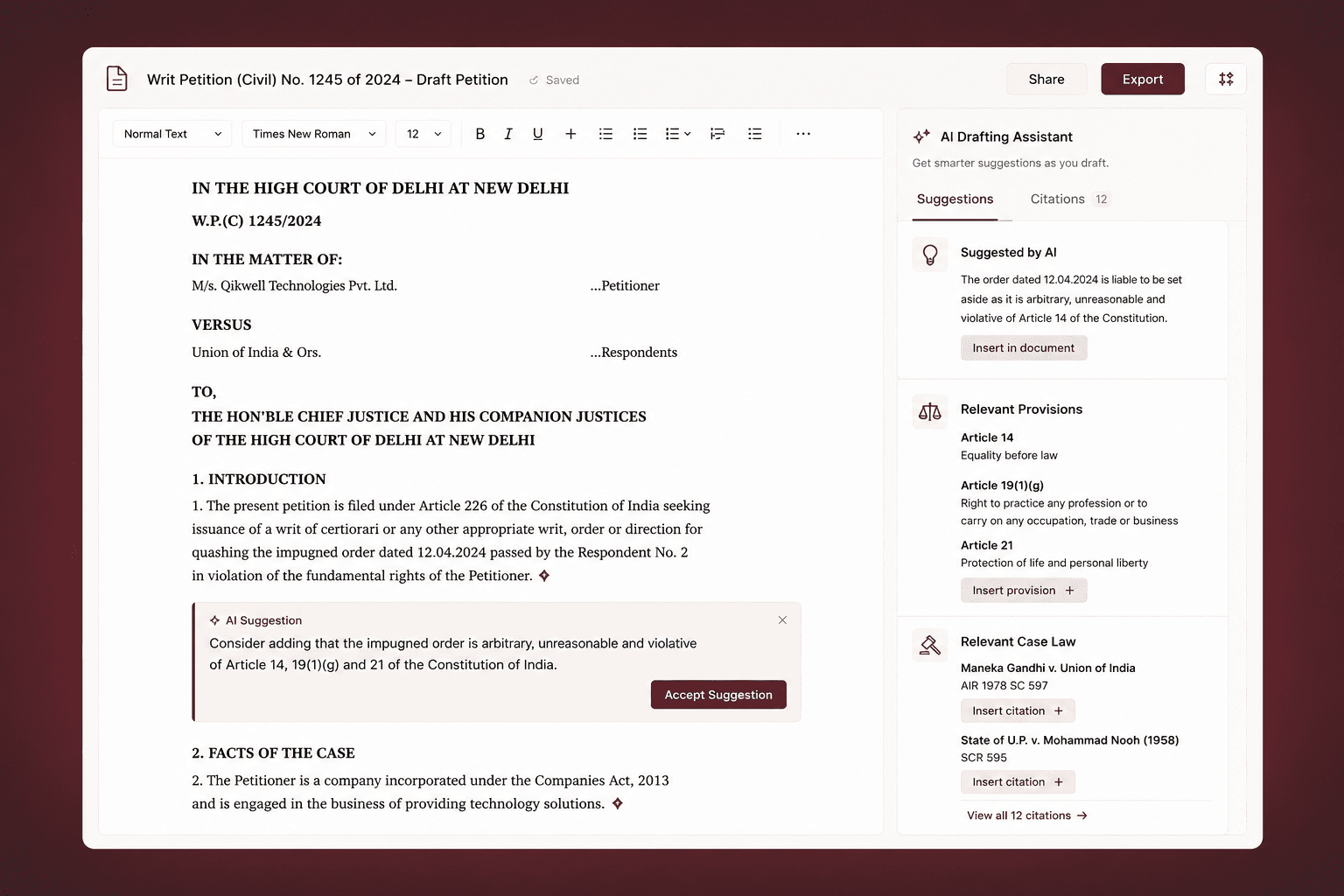
A lawyer drafting inside JurisIQ can work with AI that has access to matter documents, research outputs, extracted facts, and relevant legal context. This makes the drafting process more grounded and easier to review. AI can help identify missing issues, suggest supporting authorities, organize arguments, and maintain consistency across the document.
The goal is not to replace the lawyer's voice. *The goal is to remove the repetitive work that comes before meaningful drafting begins.*
For Indian lawyers, this can support:
- Petitions and replies
- Written submissions
- Legal notices
- Contracts and commercial documents
- Case summaries
- Client updates
- Internal matter briefs
The best drafting tools should feel like they understand where the lawyer is in the matter. They should help turn the matter record into clear, reviewable legal work.
Everything Belongs to the Matter
One of the simplest ideas behind JurisIQ is also one of the most important. Everything belongs to the matter.
Not just documents. Not just research. Not just drafts. The matter should hold the full working context of legal practice.
That includes:
- Pleadings, petitions, replies, and written submissions
- Orders, judgments, notices, and evidence
- Research queries, authorities, and notes
- Draft versions and final documents
- Hearing dates, procedural updates, and court developments
- Client instructions and internal comments
- AI interactions that shaped the work
When these pieces stay connected, the matter becomes the single source of truth. Lawyers do not need to search across five tools before starting. Teams do not need to depend on memory for every detail. The firm does not lose knowledge because a file was stored in the wrong place.
Legal practice is connected by nature. The workspace should be connected too.
Looking Ahead
The next decade of legal technology will not be defined by who has the most impressive chatbot demo. It will be defined by which systems become trusted parts of daily legal work.
Trust in legal AI will come from context, reviewability, source grounding, security, and workflow fit. Lawyers need tools that respect how legal work actually happens. They need AI that strengthens judgment rather than hiding behind confident answers.
Indian legal practice is ready for this shift. Courts are digitizing. Case volumes are rising. Clients expect faster communication. Lawyers handle more documents, more updates, and more procedural complexity than ever before. At the same time, firms need to preserve knowledge, improve productivity, and deliver consistent work across teams.
JurisIQ is being built for that reality. Not as another disconnected tool. Not as a generic AI wrapper. Not as a chatbot that forgets the matter.
JurisIQ is a connected AI workspace for Indian legal practice. It helps lawyers research faster, draft with context, organize every matter, and preserve the knowledge that makes legal work stronger over time.
Every matter should become easier to understand, easier to work on, and smarter with every step.
Start With One Matter
The best way to understand a legal workspace is not through a feature list. It is to see what happens when one matter stops being scattered.
When documents, research, drafts, hearing history, notes, and AI assistance sit together, the workflow changes. The lawyer spends less time searching. The team spends less time rebuilding context. The firm keeps more of what it learns.
That is the future we are building with JurisIQ. A workspace where Indian lawyers can focus on strategy, advocacy, and judgment while the system helps organize the work around them. A workspace where AI understands the matter before it answers. A workspace where legal intelligence compounds.

 Get Started Free